
What Is Considered Commercial Cleaning?
A lobby can look clean at 8:00 a.m. and look worked over by 10:30. That gap is where many facility issues start. If you are sorting bids, building a scope of work, or trying to figure out why one vendor calls something janitorial and another calls it commercial cleaning, the real question is simple: what is considered commercial cleaning, and what should your business expect from it?
Commercial cleaning refers to professional cleaning services performed in business, institutional, and public-use environments rather than private homes. It covers a wide range of work, from recurring office and restroom cleaning to specialty services like floor restoration, carpet extraction, post-construction cleanup, and high-touch disinfection. The defining factor is not just the type of task. It is the setting, the operational demands, and the standard of consistency required in a commercial space.
What is considered commercial cleaning in practice?
In practice, commercial cleaning includes the tasks needed to keep a business environment clean, sanitary, safe, and presentation-ready. That can mean nightly service in an office, daytime porter support in a lobby, or a detailed cleanup after construction crews leave a project site. The work is usually performed according to a custom scope based on traffic, building use, hours of operation, flooring materials, and the expectations of tenants, staff, customers, or visitors.
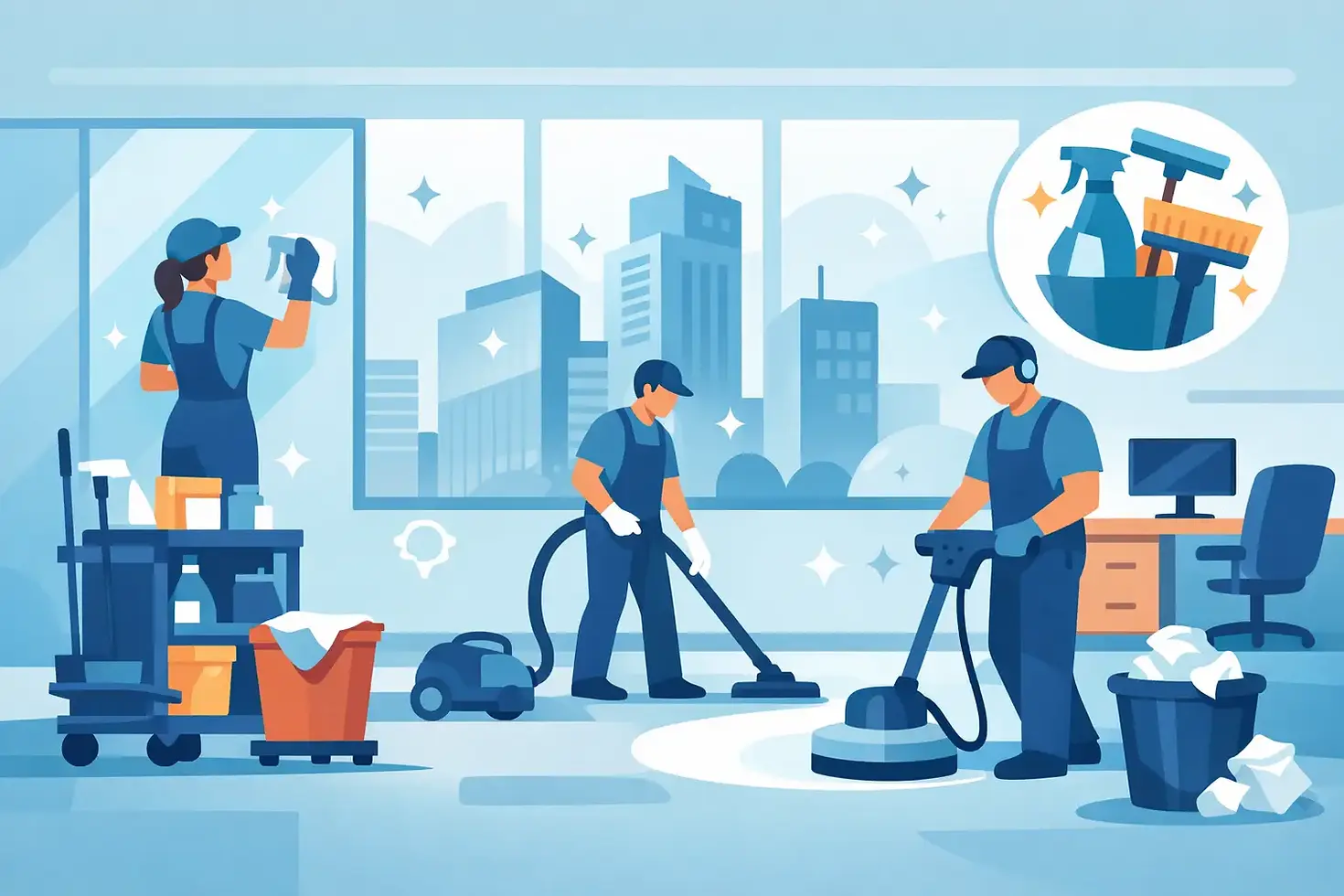
A standard commercial cleaning program often covers restrooms, breakrooms, reception areas, conference rooms, common areas, elevators, stairwells, and workspaces. Services may include trash removal, dusting, disinfecting touchpoints, vacuuming, mopping, glass cleaning, replenishing supplies, and spot cleaning throughout the property. In higher-traffic settings, the same area may need attention multiple times a day.
That is why commercial cleaning is broader than many people assume. It is not limited to visible tidiness. It is also about maintaining surfaces, protecting finishes, supporting occupant health, and helping a property operate without friction.
Commercial cleaning vs. janitorial services
This is where confusion usually happens. People often use the terms interchangeably, and sometimes vendors do too. There is overlap, but they are not always identical.
Janitorial service usually refers to routine, recurring maintenance cleaning. Think daily or several-times-per-week service that keeps a facility in working order. That includes emptying trash, cleaning restrooms, wiping surfaces, vacuuming carpet, mopping hard floors, and keeping shared spaces orderly.
Commercial cleaning is the wider category. It includes janitorial work, but it also extends to more intensive, project-based, or specialized services. A carpet extraction, a full strip and wax, machine scrubbing of large floor areas, concrete polishing, or white-glove post-construction cleanup would all fall under commercial cleaning. So if you are asking what is considered commercial cleaning, the safest answer is this: routine cleaning is part of it, but the category is much larger than day-to-day upkeep.
For buyers, the distinction matters because scopes, staffing, equipment, timing, and pricing can vary significantly. A nightly janitorial contract is not priced or planned the same way as a one-time deep cleaning or post-construction turnover.
What kinds of facilities fall under commercial cleaning?
Commercial cleaning applies to far more than traditional office suites. It covers most environments where employees, tenants, customers, students, patients, or the public move through shared space.
Typical examples include office buildings, medical offices, retail stores, schools, churches, warehouses, fitness centers, restaurants, apartment common areas, mixed-use buildings, and newly completed construction projects. In a market like New York City, it also often includes high-rise properties, busy lobbies, elevator banks, and multi-tenant common areas that need constant attention to stay presentable.
The setting changes the service approach. A small administrative office may need quiet after-hours cleaning and careful detail work around desks and electronics. A large commercial property may need porter support during business hours, restroom checks throughout the day, and floor care designed for constant foot traffic. A construction handoff may require adhesive removal, fine dust control, fixture detailing, and glass polishing before a space is ready for occupancy.
Services that are typically considered commercial cleaning
The core services are usually straightforward, but the delivery can be highly specialized. Most commercial cleaning programs include general cleaning of floors, surfaces, restrooms, kitchens or breakrooms, and common areas. Dusting, disinfecting, vacuuming, damp mopping, trash removal, liner replacement, and interior glass cleaning are all standard parts of the category.
Then there are specialty services, which become essential in facilities that need more than surface-level upkeep. Carpet cleaning and extraction help remove embedded soil and restore appearance in high-traffic zones. Hard-floor care can include stripping, waxing, burnishing, machine scrubbing, and polishing, depending on the material and the level of wear. Deep cleaning addresses buildup in corners, edges, grout lines, vents, and hard-to-reach surfaces that routine service may not fully resolve.
Post-construction cleaning is also firmly within the commercial cleaning category, but it deserves separate attention. It requires a different level of detail and a different workflow than standard maintenance. Fine dust settles everywhere. Stickers, film, caulk residue, and construction debris must be removed carefully. Floors often need specialized treatment before a property is truly turnover-ready.
That is why experienced commercial providers build cleaning around the space rather than forcing the space into a generic checklist.
What commercial cleaning does not usually include
Knowing the boundaries is just as useful as knowing the services. Not every cleaning-related task is included in a commercial cleaning contract by default.
Exterior power washing, pest control, hazardous waste remediation, mold remediation, and large-scale biohazard cleanup are usually separate services requiring different licensing, equipment, or protocols. Even within a commercial property, tasks such as replacing light bulbs, plumbing repairs, or HVAC maintenance fall outside standard cleaning unless bundled into a broader facility service agreement.
Window cleaning is another example where it depends. Interior glass is commonly included. Exterior low-rise glass may be included in some scopes. High-rise exterior glass often requires specialized crews and separate access planning.
This is one reason vague proposals create problems. If the scope simply says clean all common areas, two parties may picture very different deliverables.
Why scope matters more than labels
The label commercial cleaning is useful, but the actual scope of work is what protects service quality. Two buildings can both request commercial cleaning and need entirely different labor plans.
One property may need five-night-per-week janitorial service with periodic floor work. Another may need a daytime porter, weekly machine scrubbing, monthly carpet spotting, and quarterly deep cleaning. Neither approach is more correct. It depends on occupancy, appearance standards, budget, and how quickly the space shows wear.
For property managers and facility leaders, the best cleaning program usually starts with operational reality. How many people use the building each day? Which areas create the first impression? Where does soil collect fastest? Which floor surfaces are expensive to replace and worth protecting? When can service happen without disrupting business?
A polished commercial cleaning provider will ask these questions early because cleaning is not just labor. It is asset care, risk reduction, and presentation management.
When businesses need more than basic cleaning
A common mistake is assuming routine service alone will keep a commercial facility in top condition. It will keep things under control, but it may not reverse wear, remove deep soil, or restore finishes that have already broken down.
That is where periodic specialty work becomes important. Carpets need extraction, not just vacuuming. Vinyl and other hard floors may need stripping and waxing or machine scrubbing to maintain appearance and durability. Post-construction spaces need white-glove detailing before they are truly ready for staff, tenants, or clients. High-traffic restrooms and breakrooms may need scheduled deep cleaning to address buildup that daily service only manages at the surface.
This is especially true in dense urban properties, where traffic is constant and first impressions matter. In those environments, commercial cleaning is not a luxury line item. It is part of how a property protects its image and stays ready for business.
How to tell if a service is truly commercial grade
If you are evaluating vendors, look beyond broad promises. Commercial-grade cleaning should be defined by consistency, clear scope, trained staff, proper equipment, and a service plan built around your facility. It should also reflect the realities of your building, including timing, access, security, floor materials, and high-use pressure points.
The strongest providers are meticulous without being rigid. They know where precision matters, and they know that no two commercial spaces behave the same way. A law office, a medical suite, a retail floor, and a post-construction site all require different workflows, even when the end goal is the same: a clean, safe, polished environment that feels fully under control.
Top Tier Solutions NY works in exactly that lane, where recurring maintenance, specialty floor care, and detailed post-construction cleanup often need to operate together rather than as separate conversations.
If you are deciding what your property really needs, start with the daily reality of the space, not just the label on a proposal. The right commercial cleaning plan should make your facility look sharper, run smoother, and feel ready the moment people walk through the door.


Comments